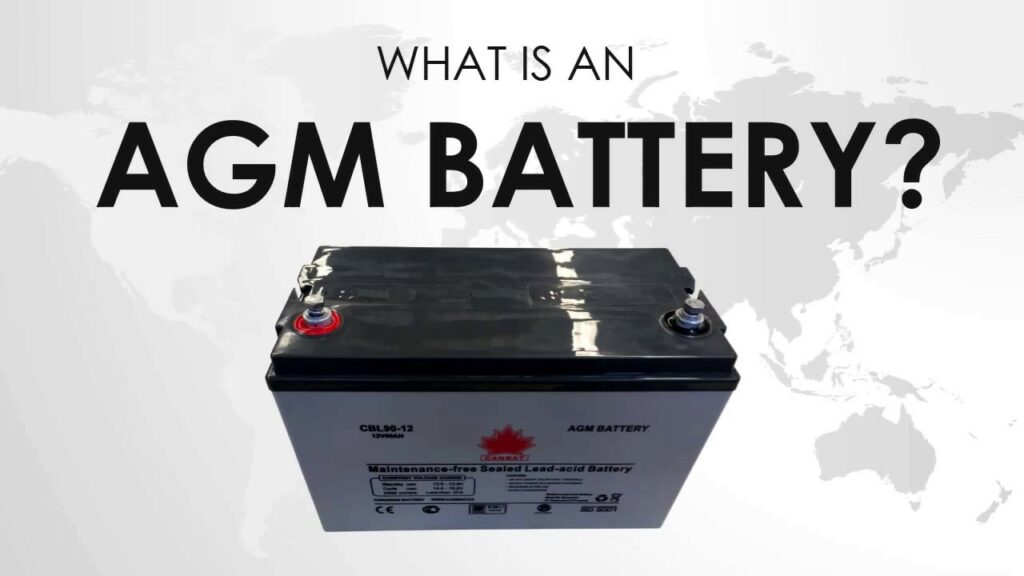
1. The Core Architecture of Absorbent Glass Mat (AGM) Technology
AGM (Absorbent Glass Mat) batteries represent a critical milestone in VRLA (Valve-Regulated Lead-Acid) engineering, specifically developed to overcome the liquid stratification and structural vulnerabilities inherent in conventional flooded lead-acid cells.
Unlike traditional batteries where plates submerge loosely in liquid acid, an AGM battery integrates ultra-fine fiberglass mats compressed tightly between the positive and negative plates. These highly porous glass fiber matrices completely absorb the sulfuric acid electrolyte through capillary action, maintaining it in an immobilized state. This tight mass design minimizes internal resistance, accelerates ion transport between active materials, and establishes a stable oxygen recombination path during the charge cycle.
2. Physical Chemistry & Operational Mechanics
The continuous efficiency of AGM technology relies on three interconnected electrochemical principles:
- Capillary Electrolyte Immobilization: By absorbing the exact volumetric requirement of sulfuric acid electrolyte, the fiberglass mats eliminate free-flowing liquid. This structural immobilization delivers a verified spill-proof rating, permitting multi-angle installation orientations (excluding inverted deployment) without risk of chemical leakage or terminal corrosion.
- Internal Oxygen Recombination Dynamics: During overcharge phases, oxygen generated at the positive plate diffuses swiftly through the unsaturated pores of the glass mat directly to the negative plate. Here, it recombines with hydrogen ions to reform water ($2H_2 + O_2 \rightarrow 2H_2O$). This internal chemical loop operates under constant pressure regulated by a one-way safety valve, negating atmospheric gas release and eliminating the need for distilled water replenishment throughout the battery’s operational lifecycle.
- Ultra-Low Internal Ohmic Resistance: The ultra-thin nature of the compressed fiberglass separator scales down the internal resistance path. This low impedance ensures rapid charge acceptance rates and facilitates immediate, high-amperage current delivery demanded by intensive industrial and automotive electrical systems.
3. Industrial Performance Benchmarks & Value Validation
For commercial buyers evaluating heavy-duty energy solutions, AGM configuration yields measurable operational upgrades over traditional flooded alternatives:
+-----------------------------------+------------------------------------+------------------------------------+
| Performance Dimension             | Conventional Flooded Batteries     | Premium AGM Engineered Cells       |
+-----------------------------------+------------------------------------+------------------------------------+
| Charge Acceptance Rate            | Baseline Standard                  | Up to 5x Faster Absorption         |
| Vibration Resilience              | Vulnerable to Plate Shedding       | 20G Mechanical Shock Mitigation    |
| Depth of Discharge (DoD)          | Recommended 50% Maximum            | Certified 80% Deep Cycle Payout    |
| Monthly Self-Discharge Rate       | 10% to 15% (At Room Temp)          | Less than 3% Static Capacity Loss  |
+-----------------------------------+------------------------------------+------------------------------------+
- Accelerated High-Current Recharging: AGM cells demonstrate superior charge acceptance. They absorb alternated current inputs up to five times faster than flooded variants, ensuring rapid power recovery essential for micro-hybrid smart powertrains and automated Start-Stop systems.
- Mitigation of Plate Shedding Under Mechanical Stress: By compressing the plate assembly within rigid cell frameworks, the fiberglass mats absorb heavy-duty vibrations in marine, material handling, and rugged off-road applications. This physical reinforcement effectively prevents plate buckling and active material shedding—the leading causes of premature internal short circuits in high-vibration zones.
- Extended Cyclic Longevity & Low Self-Discharge: Leveraging ultra-pure lead-calcium grid alloys, AGM batteries restrict the self-discharge rate to under 3% per month. This chemical stability prevents accelerating sulfation during seasonal equipment storage, guaranteeing immediate cranking readiness after prolonged inactivity.
- Sub-Zero Climate Resilience: Because the immobilized acid does not expand or freeze like bulk liquid electrolytes, the internal components remain protected against structural cracking and grid distortion in sub-zero working environments.
4. Cross-Industry Deployment Matrix (Scenario Grounding)
The deep-cycle capabilities and physical durability of AGM systems solve distinct technical pain points across specialized B2B sectors:
- Marine & Commercial Fleets: Withstands sustained multi-axis pounding, wave impact shocks, and deep-discharge demands of continuous onboard electronics, bilge pumps, and dual-purpose engine ignition.
- Off-Grid Solar & Renewable Energy Ecosystems: Functions as a reliable stationary energy storage bank. AGM arrays efficiently store fluctuating current surges generated by photovoltaic panels and withstand daily cycling without grid breakdown.
- Critical Emergency Backup & UPS Systems: Offers low-maintenance standby insurance for telecommunication towers, medical facilities, and data centers where instant, high-discharge power readiness determines system failure or success.
5. Pre-Procurement Technical Integration Audits
Prior to authorizing a fleet-wide substitution from standard flooded lead-acid units to high-performance AGM batteries, industrial purchasing teams must verify three technical integration variables:
- Alternator Charge Voltage Compatibility: AGM cells require tightly regulated charging profiles, typically capped between 14.4V and 14.8V at 25°C. Exposure to older charging systems exceeding 14.8V induces thermal runaway, vaporizing the internal electrolyte through the pressure relief valves and permanently degrading battery capacity.
- Total Cost of Ownership (TCO) Calculations: While the initial capital expenditure of an AGM unit exceeds traditional flooded models by more than 2x, procurement evaluations must calculate the long-term ROI. The elimination of routine maintenance labor costs, minimized downtime from vibration failures, and a 2-3x longer cyclic lifespan typically deliver a lower TCO over the equipment’s service life.
- Physical Compartment and Thermal Management Mapping: Ensure the targeted installation bay provides adequate thermal shielding. High ambient heat shortens the operational life of all VRLA configurations, necessitating intelligent positioning away from raw engine heat sources.
 English
  Portuguese
  Spanish
  Japanese
  Korean
  Arabic
  Dutch
Dutch  French
  German
  Italian
  Indonesian
  Greek
Greek  Turkish
  Chinese (Taiwan)
  Chinese (China)
Leave a Reply
You must be logged in to post a comment.